
Just got back from a two-day [semi-marathon] road trip through South Carolina, and one of the things I finally did (after putting it off for three years) was visit Anson Mills off Gervais Street in downtown Columbia.
They have a very cool set up, with several types of mills (several are from Meadows Mills in North Wilkesboro, N.C.) and a whole lotta chest freezers (in which they freeze their pre-ground corn and their finished products) throughout their warehouse.
I was able to obtain some buckwheat flour, oat flour, blue grits (made from Cherokee Blue corn), and rice grits.
Can't wait to cook with them! First, I think I'm going to make Anson Mills' recipe "Carolina Gold Rice Grits with Shallots and Celery" as a side to a "Poulet Rouge" chicken from Ashley Farms/Joyce Foods. Mmmm...
(The other foodie highlight in S.C. was Cooper's Country Store in/near Salters, where I bought two BBQ turkey sandwiches, a bag of boiled peanuts, and some salt and vinegar pork rinds for my dinner; they are "famous" for their country hams, which I assumed are produced on premise, but may not be -- they are also somewhat mysteriously "famous" for their rice cookers/steamers. Their meat counter made me seriously drool.)
Showing posts with label corn. Show all posts
Showing posts with label corn. Show all posts
Wednesday, May 14, 2008

Monday, April 28, 2008
"Raise hell, not corn"
(From Grist)
A great article about how one should definitely contact one's politicians (especially since it's time to vote again!) and take action on the sorry state of the industrial food system.
"When nearly 75 percent of the U.S. market spinach crop is grown in one valley in California and repeated bacterial contaminations ensue, we need to question our reliance on the corporate food system.
When millions of pounds of beef are recalled due to bacterial contamination and when, by the count of the Centers for Disease Control, 76 million Americans get food poisoning and 73,000 cases of e coli infection and 63 deaths occur in the U.S. each year, we need to question our reliance on the corporate food system.
When the World Health Organization tells us that some 60 percent of the adults and nearly 13 percent of the children in America are obese, we need to question our reliance on the corporate food system.
When scientists from around the world tell us the vitamin and mineral content of our food has fallen significantly over the past 60 years, we need to question our reliance on the corporate food system.
When groundwater nitrate levels climb year after year because industrial size farms raise too many animals producing too much manure on too little land, we must question the industrial concentration of our food system. "
'nuff said...
A great article about how one should definitely contact one's politicians (especially since it's time to vote again!) and take action on the sorry state of the industrial food system.
"When nearly 75 percent of the U.S. market spinach crop is grown in one valley in California and repeated bacterial contaminations ensue, we need to question our reliance on the corporate food system.
When millions of pounds of beef are recalled due to bacterial contamination and when, by the count of the Centers for Disease Control, 76 million Americans get food poisoning and 73,000 cases of e coli infection and 63 deaths occur in the U.S. each year, we need to question our reliance on the corporate food system.
When the World Health Organization tells us that some 60 percent of the adults and nearly 13 percent of the children in America are obese, we need to question our reliance on the corporate food system.
When scientists from around the world tell us the vitamin and mineral content of our food has fallen significantly over the past 60 years, we need to question our reliance on the corporate food system.
When groundwater nitrate levels climb year after year because industrial size farms raise too many animals producing too much manure on too little land, we must question the industrial concentration of our food system. "
'nuff said...
Friday, January 11, 2008
Current thangs
Still am narrowing down my seed wantings from the seed catalogs... I've gotten rid of some from my list I had wanted, but added others I hadn't previously know about. I have already pre-ordered some German Butterball seed potatoes from SSE, however, as last spring I was too late and they were sold out.
I may just plant my saved Stowell's corn seed. Nothing really excites me that is "dual purpose" (one of the purposes being "sweet"), although I still may try and find some Tuscarora/Iroquois White seed to plant. I thought about Gourdseed (again), but since I won't be making meal for awhile, I don't see the point. Decisions, decisions...
AND, it's about time to order chickens for this year.
My main garden is still doing ok, even though the weather has been fluctuating between 15 and 80 degrees lately! My broccoli is hanging in there, as well as a speckled lettuce and my carrots. My garlic is still going strong (but it has awhile to go), and my onions are doing well, but some deer infiltrated my [very low] fence and munched many of the tops. Who knew?! I thought deer wouldn't like onion greens, but obviously they do.
Although a bit late (or early, depending on how you look at it), I've been thinking about what kind of fruit and nut trees I want to plant (a few different kinds of apples, a pecan or two, a few black walnut, and a pear or two). I have an area in mind to plant them in, but need to do some land clearing first anyway (so, I guess it will happen next fall). A man named Creighton Lee Calhoun lives about an hour south of me, and he is considered by many to be the apple guru for the South. Too bad (for me) that he doesn't sell heritage apple trees anymore, but he still works his magic at Horne Creek Living Historical Farm and the trees can still be purchased locally through Century Farm Orchards.
I may just plant my saved Stowell's corn seed. Nothing really excites me that is "dual purpose" (one of the purposes being "sweet"), although I still may try and find some Tuscarora/Iroquois White seed to plant. I thought about Gourdseed (again), but since I won't be making meal for awhile, I don't see the point. Decisions, decisions...
AND, it's about time to order chickens for this year.
My main garden is still doing ok, even though the weather has been fluctuating between 15 and 80 degrees lately! My broccoli is hanging in there, as well as a speckled lettuce and my carrots. My garlic is still going strong (but it has awhile to go), and my onions are doing well, but some deer infiltrated my [very low] fence and munched many of the tops. Who knew?! I thought deer wouldn't like onion greens, but obviously they do.
Although a bit late (or early, depending on how you look at it), I've been thinking about what kind of fruit and nut trees I want to plant (a few different kinds of apples, a pecan or two, a few black walnut, and a pear or two). I have an area in mind to plant them in, but need to do some land clearing first anyway (so, I guess it will happen next fall). A man named Creighton Lee Calhoun lives about an hour south of me, and he is considered by many to be the apple guru for the South. Too bad (for me) that he doesn't sell heritage apple trees anymore, but he still works his magic at Horne Creek Living Historical Farm and the trees can still be purchased locally through Century Farm Orchards.
Monday, October 8, 2007
Acting corny
For the 2007 season, I grew Stowell's (a.k.a Stowell's Evergreen), which is/was a fine corn and all, but perhaps as a friend of mine said, it is one of those heirloom corns that you'd better already have the water boiling before you even pick it. I only grew about 200 stalks of it, so it wasn't too much of a waste of space or time.
So, I of course would pick it a few hours before I cooked and ate it, and wasn't very impressed by its taste. I did save some of the seed (about a quart canning jar's worth), however, just in case I feel compelled to plant it again next year. I also saved a sack of it for chicken feed, as I'm getting a few Dominiques for 2008. Much of the corn was eaten up by worms at the last minute, just before I picked it (it's my own fault really, as I didn't take the necessary precautions).
I may bring it into the twentieth century with corn, however, and plant either Hasting's Prolific or something similar (as a sweet corn) ... but I also may go the other way and plant either Tuscarora (a.k.a Iroquios) White or Gourdseed, both at least eighteenth-century corns (and probably earlier).
By the way, if anyone knows where to obtain some Hasting's Prolific seed, please let me know; I may need to write Don Hastings (no, not the actor; the guy whose grandfather originated the corn type, and who is the writer of several modern gardening books) and ask him about it.
So, I of course would pick it a few hours before I cooked and ate it, and wasn't very impressed by its taste. I did save some of the seed (about a quart canning jar's worth), however, just in case I feel compelled to plant it again next year. I also saved a sack of it for chicken feed, as I'm getting a few Dominiques for 2008. Much of the corn was eaten up by worms at the last minute, just before I picked it (it's my own fault really, as I didn't take the necessary precautions).
I may bring it into the twentieth century with corn, however, and plant either Hasting's Prolific or something similar (as a sweet corn) ... but I also may go the other way and plant either Tuscarora (a.k.a Iroquios) White or Gourdseed, both at least eighteenth-century corns (and probably earlier).
By the way, if anyone knows where to obtain some Hasting's Prolific seed, please let me know; I may need to write Don Hastings (no, not the actor; the guy whose grandfather originated the corn type, and who is the writer of several modern gardening books) and ask him about it.
Sunday, September 30, 2007
Corn causing problems again
When will outdated monoculture corn farmers come to their senses and give up on growing thousands of acres of corn each season? And when will the government quit giving our tax money away (via subsidies) that really only benefit the big processing companies (like Cargill, Archer Daniels Midlands, Monsanto, et al)?
Well, hopefully the bubble will burst soon. A recent article in the New York Times seems to point to another wrench in their gears. (Unfortunately farmers are going to take the biggest hit when the bubble bursts; but again, time to adapt and move on.)
Here's an update.
[On the flip side, here's an article on cellulosic ethanol that sounds promising.]
Well, hopefully the bubble will burst soon. A recent article in the New York Times seems to point to another wrench in their gears. (Unfortunately farmers are going to take the biggest hit when the bubble bursts; but again, time to adapt and move on.)
Here's an update.
[On the flip side, here's an article on cellulosic ethanol that sounds promising.]
Wednesday, September 5, 2007
The State of the Garden Address (SotGA) #1
Well, my garden's pretty much done with its spring/summer crops, and I just recently planted some fall/winter ones. So far, I've planted (from seed): mustard, cabbage, collards, turnips, kale, lettuce (Grandpa Admire and Black Seeded Simpson), carrots (Oxheart and Touchon), and broccoli. I even planted nine Packman broccoli plants, in case the seed-started ones don't do well. I still have yet to plant some winter squash and some garlic and perhaps even some shallots.
My Cherokee Purple tomatoes are still producing (although not as well as they were; I think the drought's affected them), as are my (late-planted) San Marzano tomatoes. My Marglobes are still producing a few small tomatoes as well. The Cherokee Purples were a big hit amongst everyone I shared them with, and they are likely the best tomato I've ever eaten (I/we have Craig LeHoullier to thank for that).
I still have two squash plants left, but they don't seem to be producing right now (perhaps anymore). My Fin de Bagnol beans are through, and my Ichiban eggplants are long gone (they both apparently fell victim to the drought, and to a problem with my irrigation system). My jalapeno and tabasco pepper plants are still going strong, as are my okra plants. I'm going to pickle my okra, and turn most of the jalapenos into chipotle peppers (by drying and smoking them); I may try pickling some of them as well.
My corn did fine, but it (Stowell's Evergreen) wasn't the best sweet corn I've ever had. Plus, without using pesticides, the ears got eaten up by worms, and I wasn't able to harvest as many as I'd wished. I may try Country Gentleman or a similar open-pollinated corn next year (I'm not quite desperate enough to go back to a hybrid like Silver Queen quite yet).
The only crop that was destroyed by wildlife (deer) was my sweet potatoes. But, it was my fault as I didn't make the fence high enough. And anyway, perhaps the deer meat will taste sweeter this year!
My Cherokee Purple tomatoes are still producing (although not as well as they were; I think the drought's affected them), as are my (late-planted) San Marzano tomatoes. My Marglobes are still producing a few small tomatoes as well. The Cherokee Purples were a big hit amongst everyone I shared them with, and they are likely the best tomato I've ever eaten (I/we have Craig LeHoullier to thank for that).
I still have two squash plants left, but they don't seem to be producing right now (perhaps anymore). My Fin de Bagnol beans are through, and my Ichiban eggplants are long gone (they both apparently fell victim to the drought, and to a problem with my irrigation system). My jalapeno and tabasco pepper plants are still going strong, as are my okra plants. I'm going to pickle my okra, and turn most of the jalapenos into chipotle peppers (by drying and smoking them); I may try pickling some of them as well.
My corn did fine, but it (Stowell's Evergreen) wasn't the best sweet corn I've ever had. Plus, without using pesticides, the ears got eaten up by worms, and I wasn't able to harvest as many as I'd wished. I may try Country Gentleman or a similar open-pollinated corn next year (I'm not quite desperate enough to go back to a hybrid like Silver Queen quite yet).
The only crop that was destroyed by wildlife (deer) was my sweet potatoes. But, it was my fault as I didn't make the fence high enough. And anyway, perhaps the deer meat will taste sweeter this year!
Thursday, July 19, 2007
Land, Corn, and Ethanol
There was an article in USA Today today (July 18) about how due to ethanol, corn prices have risen dramatically which has caused land prices to skyrocket in the Midwestern U.S.
The article, Land prices leave farmers in a lurch, by Sue Kirchhoff, can be found in its entirety at: http://www.usatoday.com/money/industries/food/2007-07-18-farmland-prices_N.htm.
But here is a few verbatim excerpts from the article that I found to be particularly interesting:
"Looking ahead, it's hard to overstate the potential impacts of the ethanol industry. Acting in response to government subsidies and mandates to combat global warming and reduce U.S. demand for imported oil, about 20% of U.S. corn production is now dedicated to ethanol. Corn prices more than doubled to nearly $4 a bushel on futures markets, before falling recently. Corn closed on the Chicago Board of Trade Wednesday [July 18, 2007] up 4½ cents at $3.27 — still historically high. The price rise has increased the number of farmers buying land to expand."
"'It's all driven by corn prices, but is this sustainable?' says University of Nebraska economist Bruce Johnson, speaking of a 14% rise in land values across the state in the 12 months ended in February. 'We have to be really cautious here so that we don't fall into chasing appreciation.' "
"Rising prices for corn and other crops are pushing up land prices and having other indirect effects. Getting to Paulman's farm means driving through miles of lush corn fields watered by huge wheel-mounted sprinklers. The thirsty corn crop is straining water supplies. If corn prices stay high, farmers could take more fragile land out of the federal Conservation Reserve Program."
"There is a sense of uncertainty beneath the buoyant prices and rush of ethanol plant start-ups here. Federal ethanol economics include a 51-cent-per-gallon tax credit for petroleum firms that blend ethanol, a 54-cent-per-gallon tariff on imported ethanol and tax incentives for smaller firms. States have their own programs."
"'The goal was for ethanol … to create a local market for corn over which farmers had better control than they had historically' with much of their product exported out of state, say Todd Sneller, administrator of the of the Nebraska Ethanol Board, a state agency. 'I don't think any of these communities would have been willing to host (ethanol) plants if they thought this was short term.'"
What are the morals of this story as see it?
1. Too many farmers overly rely on subsidies.
2. 20% of U.S. corn production is now dedicated to ethanol ... that's a heck of a lot of corn taken away from feeding livestock.
3. Farmers complain when corn prices are down, and they complain when they're up as well.
4. Greedy farmers taking more land out of the federal Conservation Reserve Program, which is not a good thing, as it will greatly increase erosion and other related problems.
5. Government taxes are too high on alternative fuels.
There's a lot more to it, so read the article (and the related Water constraints rain on ethanol zeal article).
The article, Land prices leave farmers in a lurch, by Sue Kirchhoff, can be found in its entirety at: http://www.usatoday.com/money/industries/food/2007-07-18-farmland-prices_N.htm.
But here is a few verbatim excerpts from the article that I found to be particularly interesting:
"Looking ahead, it's hard to overstate the potential impacts of the ethanol industry. Acting in response to government subsidies and mandates to combat global warming and reduce U.S. demand for imported oil, about 20% of U.S. corn production is now dedicated to ethanol. Corn prices more than doubled to nearly $4 a bushel on futures markets, before falling recently. Corn closed on the Chicago Board of Trade Wednesday [July 18, 2007] up 4½ cents at $3.27 — still historically high. The price rise has increased the number of farmers buying land to expand."
"'It's all driven by corn prices, but is this sustainable?' says University of Nebraska economist Bruce Johnson, speaking of a 14% rise in land values across the state in the 12 months ended in February. 'We have to be really cautious here so that we don't fall into chasing appreciation.' "
"Rising prices for corn and other crops are pushing up land prices and having other indirect effects. Getting to Paulman's farm means driving through miles of lush corn fields watered by huge wheel-mounted sprinklers. The thirsty corn crop is straining water supplies. If corn prices stay high, farmers could take more fragile land out of the federal Conservation Reserve Program."
"There is a sense of uncertainty beneath the buoyant prices and rush of ethanol plant start-ups here. Federal ethanol economics include a 51-cent-per-gallon tax credit for petroleum firms that blend ethanol, a 54-cent-per-gallon tariff on imported ethanol and tax incentives for smaller firms. States have their own programs."
"'The goal was for ethanol … to create a local market for corn over which farmers had better control than they had historically' with much of their product exported out of state, say Todd Sneller, administrator of the of the Nebraska Ethanol Board, a state agency. 'I don't think any of these communities would have been willing to host (ethanol) plants if they thought this was short term.'"
What are the morals of this story as see it?
1. Too many farmers overly rely on subsidies.
2. 20% of U.S. corn production is now dedicated to ethanol ... that's a heck of a lot of corn taken away from feeding livestock.
3. Farmers complain when corn prices are down, and they complain when they're up as well.
4. Greedy farmers taking more land out of the federal Conservation Reserve Program, which is not a good thing, as it will greatly increase erosion and other related problems.
5. Government taxes are too high on alternative fuels.
There's a lot more to it, so read the article (and the related Water constraints rain on ethanol zeal article).
Tuesday, July 10, 2007
"Every once in a while, you can spot a couple of cattle fighting over a whole potato"
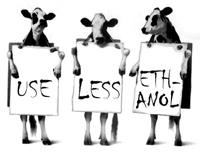
This story is both amusing and amazing:
http://online.wsj.com/public/article_print/SB117971270570109153-zOC0IHWiWPWox_jaHb4rBiWVpIo_20070528.html%3f
The article basically discusses several of the problems with using corn for ethanol production instead of for livestock feed. The main problem I have with it is one of the last paragraphs: "In ethanol-producing states, some farmers have been able to mitigate high corn costs by feeding their animals dried distillers' grains, a corn mash left over from ethanol production. But in states without ethanol plants, distillers' grains aren't always readily available. Also, many farmers say the product lacks sufficient nutrients. Others say their animals don't like the taste."
For one, "dried distillers' grains" (especially when reconstituted) have a higher nutrional value than the pre-distilled grains, due to the fermentation process; second, have you ever seen a pig fed fermented grain of any type? They go NUTS over it!
Another amusing/disturbing statement within the article is regarding the price of corn: "[it] has prompted livestock groups like the National Cattlemen's Beef Association and the National Chicken Council to call for an end to federal ethanol subsidies ..." Now that's a bit of a hypocritical statement, ain't it? I guess it's ok when the federal government subsidizes corn (giving away many billions of dollars of U.S. tax payers' money) for animal feed though!
http://online.wsj.com/public/article_print/SB117971270570109153-zOC0IHWiWPWox_jaHb4rBiWVpIo_20070528.html%3f
The article basically discusses several of the problems with using corn for ethanol production instead of for livestock feed. The main problem I have with it is one of the last paragraphs: "In ethanol-producing states, some farmers have been able to mitigate high corn costs by feeding their animals dried distillers' grains, a corn mash left over from ethanol production. But in states without ethanol plants, distillers' grains aren't always readily available. Also, many farmers say the product lacks sufficient nutrients. Others say their animals don't like the taste."
For one, "dried distillers' grains" (especially when reconstituted) have a higher nutrional value than the pre-distilled grains, due to the fermentation process; second, have you ever seen a pig fed fermented grain of any type? They go NUTS over it!
Another amusing/disturbing statement within the article is regarding the price of corn: "[it] has prompted livestock groups like the National Cattlemen's Beef Association and the National Chicken Council to call for an end to federal ethanol subsidies ..." Now that's a bit of a hypocritical statement, ain't it? I guess it's ok when the federal government subsidizes corn (giving away many billions of dollars of U.S. tax payers' money) for animal feed though!
Perhaps they should quit selling their now high-priced corn they produce that was originally intended to feed their livestock, or they can protect their corn subsidy money another way?
Thursday, June 28, 2007
Alternative fuels
Of course, for many reasons, we need to find an alternative to petroleum-based motor fuels, and as soon as possible (if not 30 years ago). And, it appears as if the United States is looking towards ethanol to be the official answer to the gasoline replacement question. My main concerns with using ethanol are that it will continue the BILLIONS of dollars in corn subsidies paid by the government (especially to the VERY large commercial farmers), and that protected and/or at-risk lands might be planted in corn in order to cash in even further on the production of corn (including more forests – and especially our national parks -- will be stripped to use the wood for ethanol production). Of course, both resources (corn and trees) are renewable resources, but you know that the large corporate farmers and the lumber companies (et al.) will eventually get greedy with our natural resources (much like the oil companies do now) and the American public will suffer for it. Plus, larger amounts of genetically-modified (GM) corn and etc. will be grown, and bioengineered yeast strains, which is bad for everyone and everything but the biotech companies. Right now, my only ‘pro’ regarding corn-based ethanol production is that the byproduct (the mash) can be used as a very efficient protein feed for livestock production or even human consumption (although ex- Chairman of the Board of Governors of the Federal Reserve Alan Greenspan feels that animals will go hungry once ethanol production increases!).
It is interesting to see President Bush visiting Brazil to talk about ethanol production; I’d like to see what comes of it. I understand Brazil is focusing on sugar cane-based ethanol (as is Cuba and a few other countries), but I also understand that virgin rainforests may suffer (much like our national parks may suffer) once land for sugar cane production becomes too valuable to let just “lie around” and be unproductive commercially. Anyway, President Bush seems to be focusing on corn stalks, wood chips from fast-growing trees, and switchgrass for the biomass needed for ethanol production; perhaps he feels that using the ears of corn or other edible biomass will result in people drinking the finished product?
Marty Bender, a scientist at the Land Institute in Kansas, conducted studies in the 1990s that documented that an alternative fuel source such as ethanol (as a large-scale and/or total replacement for gasoline) would be ecologically inefficient and agriculturally destructive in the long run because it may cause the cultivation of every possible acre of ground (including erosive lands that have the potential to stabilize our watersheds, for instance) in order to produce the biomass needed for the tremendous supply that would be required. Plus, it would most likely decrease the food supply (perhaps greatly) nationwide and worldwide if land is considered more valuable to use for the production of fuel biomass than for edible grains.
Of course, I don’t know the answer to what the most effective (in every way) “alternative” fuel is. Perhaps using methane or another form of composting gas (i.e. as a byproduct of composting) will work; maybe algae; perhaps hydrogen would be the most efficient; perhaps biodiesel is the key; maybe fuel cells; heck, possibly solar or thermal heat will work. I’m just not sure. It’d be nice to be able to use something that’s already serving or served its main purpose (in a byproduct or recycling-kinda way), such as landfill gas or sludge, or livestock manure, or urban sewage (perhaps biosolids, even with their heavy metals), or normally unrecyclable plastics or waxed cardboard. Again, I’m just not sure what the answer is. I do think that with so many vehicles on the road that utilize gasoline, something that those vehicles can use directly or be adapted to use would be most practical, at least in the short term (with the “short term” being perhaps 20 years or so). For instance, on my salary, I’m not going to buy a brand-new 2010 year-model truck that runs on hydrogen fuel cells, I’m going to find a way to adapt or convert my 1978 Ford F-150 to use something other than gasoline (I know, I know…perhaps I should have bought a diesel). Perhaps a combination of “alternative” fuels would be best overall, as then no singular resource will be wiped out, exploited by private business interests or governments, or overly affect the environment in a negative way, and people can tailor their fuel needs to their locality and to vehicular or home heating (again, or whatever) requirements. As Rachel Burton of Piedmont Biofuels (in Chatham County, N.C.), who seems to have coined the rather brilliant term ‘Slow Fuel’ (a modification of the term ‘Slow Food’), says, “we are believers in a micro-nodal model of energy production that insists that energy be harnessed where it is used … we have decided to include fuel in our 100 mile diet.”
It is interesting to see President Bush visiting Brazil to talk about ethanol production; I’d like to see what comes of it. I understand Brazil is focusing on sugar cane-based ethanol (as is Cuba and a few other countries), but I also understand that virgin rainforests may suffer (much like our national parks may suffer) once land for sugar cane production becomes too valuable to let just “lie around” and be unproductive commercially. Anyway, President Bush seems to be focusing on corn stalks, wood chips from fast-growing trees, and switchgrass for the biomass needed for ethanol production; perhaps he feels that using the ears of corn or other edible biomass will result in people drinking the finished product?
Marty Bender, a scientist at the Land Institute in Kansas, conducted studies in the 1990s that documented that an alternative fuel source such as ethanol (as a large-scale and/or total replacement for gasoline) would be ecologically inefficient and agriculturally destructive in the long run because it may cause the cultivation of every possible acre of ground (including erosive lands that have the potential to stabilize our watersheds, for instance) in order to produce the biomass needed for the tremendous supply that would be required. Plus, it would most likely decrease the food supply (perhaps greatly) nationwide and worldwide if land is considered more valuable to use for the production of fuel biomass than for edible grains.
Of course, I don’t know the answer to what the most effective (in every way) “alternative” fuel is. Perhaps using methane or another form of composting gas (i.e. as a byproduct of composting) will work; maybe algae; perhaps hydrogen would be the most efficient; perhaps biodiesel is the key; maybe fuel cells; heck, possibly solar or thermal heat will work. I’m just not sure. It’d be nice to be able to use something that’s already serving or served its main purpose (in a byproduct or recycling-kinda way), such as landfill gas or sludge, or livestock manure, or urban sewage (perhaps biosolids, even with their heavy metals), or normally unrecyclable plastics or waxed cardboard. Again, I’m just not sure what the answer is. I do think that with so many vehicles on the road that utilize gasoline, something that those vehicles can use directly or be adapted to use would be most practical, at least in the short term (with the “short term” being perhaps 20 years or so). For instance, on my salary, I’m not going to buy a brand-new 2010 year-model truck that runs on hydrogen fuel cells, I’m going to find a way to adapt or convert my 1978 Ford F-150 to use something other than gasoline (I know, I know…perhaps I should have bought a diesel). Perhaps a combination of “alternative” fuels would be best overall, as then no singular resource will be wiped out, exploited by private business interests or governments, or overly affect the environment in a negative way, and people can tailor their fuel needs to their locality and to vehicular or home heating (again, or whatever) requirements. As Rachel Burton of Piedmont Biofuels (in Chatham County, N.C.), who seems to have coined the rather brilliant term ‘Slow Fuel’ (a modification of the term ‘Slow Food’), says, “we are believers in a micro-nodal model of energy production that insists that energy be harnessed where it is used … we have decided to include fuel in our 100 mile diet.”
Heirloom seed
I have become obsessed with heirloom seeds. I’m actually even starting (this year) to save specific seed (corn and peppers for now) so as to make my seed what is termed “land race,” where a specific animal or vegetable over time becomes totally adapted to a specific place’s climate and land or soil. I’m beginning to land race my Stowell’s (sweet) corn, and within the next few years (I’ll have to clear some land I guess) will do it with a Southern dent-style of corn – probably Gourdseed but perhaps Hickory King or Boone County White. I’m also thinking of saving some of the seeds from my Cherokee Purple tomato plants for next year’s garden, but since I have other types of tomatoes growing near them and they might cross-pollinate, I may not.
Many seeds are heirloom anyway: even major companies like Burpee and Wal Mart sell some heirloom seeds (like yellow crookneck squash or Brandywine tomatoes). As long as it’s not a hybrid, or genetically modified (which yellow crookneck squash can be these days), it’s probably an heirloom variety. Heck, even some hybrids are nearly considered to be heirlooms nowadays (especially certain corn or tomato types), as they’ve been grown by some families for generations.
Many seeds are heirloom anyway: even major companies like Burpee and Wal Mart sell some heirloom seeds (like yellow crookneck squash or Brandywine tomatoes). As long as it’s not a hybrid, or genetically modified (which yellow crookneck squash can be these days), it’s probably an heirloom variety. Heck, even some hybrids are nearly considered to be heirlooms nowadays (especially certain corn or tomato types), as they’ve been grown by some families for generations.
Subscribe to:
Posts (Atom)