
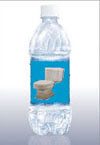
PepsiCo just got "busted" for bottling treated/purified tap water and selling it for more money than you would pay for it directly out of your own faucet.
Well, normally I am all for the consumer's right for truth in labelling of food and food-type products, but this one is a bit ridiculous. I mean, they (Aquafina and Dasani, for example) already pretty much said that they were obtaining their water from the tap, only they used an acronym ("P.W.S." or public water source). Now, if they had said they got their water from some special spring somewhere, THAT would be misleading.
Groups such as "Think Outside the Bottle" obviously do not understand the problems with tap water, however. Public tap water can be very good and contaminant free at its source, but once it goes through all those miles of leaky public water pipes (that can be contaminated from adjacent sewer pipes or by contaminated ground water that seeps into the pipes), then into your house through some corroded (and likely lead, if it's an old house or building) pipes, it isn't as clean as when it's tested directly at the public water source. Every time I drink tap water, I tend to drink it as fast as I can and drink as little as possible, and while grimacing. A restaurant serving tap water to me is the same as if that restaurant served food that has pesticides, herbicides, and hormones in it. I generally only drink tap water at a restaurant when I'm feeling too cheap to pay $3+ for a bottle of water.
I understand that many, many thousands of used plastic water bottles litter cities, highways, and etc. across the globe, but the two things about that are: that it's better to have guaranteed clean water than potentially contaminated tap water, and the general consumer wants convenience, even at the cost of the environment and/or how much they have to pay for it, money wise.
If nothing else comes out of this "truth in labelling" occurrence, perhaps we will one day have our food labelled with country of origin, poisons used during production, whether it's a GM product, etc. Or, maybe what we should take away from Aquafina example is that PepsiCo doesn't have as many special-interest congressional lobbyists as Monsanto does!
On the amusing side, here's an extreme of 'truth in labelling': http://business.timesonline.co.uk/tol/business/enterprise/article640266.ece
Well, normally I am all for the consumer's right for truth in labelling of food and food-type products, but this one is a bit ridiculous. I mean, they (Aquafina and Dasani, for example) already pretty much said that they were obtaining their water from the tap, only they used an acronym ("P.W.S." or public water source). Now, if they had said they got their water from some special spring somewhere, THAT would be misleading.
Groups such as "Think Outside the Bottle" obviously do not understand the problems with tap water, however. Public tap water can be very good and contaminant free at its source, but once it goes through all those miles of leaky public water pipes (that can be contaminated from adjacent sewer pipes or by contaminated ground water that seeps into the pipes), then into your house through some corroded (and likely lead, if it's an old house or building) pipes, it isn't as clean as when it's tested directly at the public water source. Every time I drink tap water, I tend to drink it as fast as I can and drink as little as possible, and while grimacing. A restaurant serving tap water to me is the same as if that restaurant served food that has pesticides, herbicides, and hormones in it. I generally only drink tap water at a restaurant when I'm feeling too cheap to pay $3+ for a bottle of water.
I understand that many, many thousands of used plastic water bottles litter cities, highways, and etc. across the globe, but the two things about that are: that it's better to have guaranteed clean water than potentially contaminated tap water, and the general consumer wants convenience, even at the cost of the environment and/or how much they have to pay for it, money wise.
If nothing else comes out of this "truth in labelling" occurrence, perhaps we will one day have our food labelled with country of origin, poisons used during production, whether it's a GM product, etc. Or, maybe what we should take away from Aquafina example is that PepsiCo doesn't have as many special-interest congressional lobbyists as Monsanto does!
On the amusing side, here's an extreme of 'truth in labelling': http://business.timesonline.co.uk/tol/business/enterprise/article640266.ece
..........
Here's some updates (8-20-2007) regarding bottled water issues:
http://cityroom.blogs.nytimes.com/2007/08/14/how-do-you-take-your-water
http://cityroom.blogs.nytimes.com/2007/08/14/how-do-you-take-your-water
and on the plastic bottles themselves:

