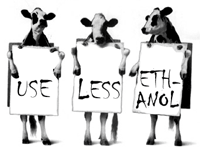
It's February 27 - March 1, by the way.
Saturday, January 10, 2009
A cool local event heads up
It's February 27 - March 1, by the way.
Sunday, May 18, 2008
Farmers, consumers, and organic food
The first article, Natural Response: As prices of organic foods rise, plain old fruits and vegetables suddenly look better, shows not only the fickleness and apathy of the average consumer, but also that when it comes down to it, many (if not most) farmers want to make money over doing what is right for the consumer and the environment.
However, as I feel organic foodstuffs are overrated in many ways anyway, I'm glad to see that locally-produced foodstuffs are being preferred by consumers as they tend to be cheaper (mainly due to almost zero transportation costs) and fresher (and may be organic anyway, or perhaps even "beyond organic"). The second article, Shoppers Choosing Local Over Organics in Produce, addresses this issue/these issues.
One interesting statement from the second article is that "33 percent [of consumers] are concerned about the safety of organic produce." Is it because USDA organic standards have been lowered in many categories and also been manipulated by producers, or is it due to anti-organic propaganda like when organic spinach was blamed for the E. coli outbreak in late 2006, when in fact it was conventional bagged spinach?
Wednesday, April 30, 2008
The agro-industrial complex
An important independent report, Putting Meat on the Table: Industrial Farm Animal Production in America, by the Pew Charitable Trusts and Johns Hopkins Bloomberg School of Public Health has been released, concluding that "Industrial animal farming in the United States needs to make many major reforms in order to protect public health and the environment."
+ The report criticized "the agro-industrial complex" in regards to:
+ their over-and mis-use of antibiotics
+ the pollution created by overcrowded factory farms
+ the spread of disease in overcrowded feedlots
+ the inhumane treatment of confined animals
+ the industry's influence on agricultural research and governmental regulation
... amongst other things
Read the report in its entirety here: http://www.ncifap.org/_images/PCIFAP%20FINAL%20REPORT.pdf
Friday, September 28, 2007
Beyond [USDA] Organic

The man who has really pushed the idea of “beyond organic” is Joel Salatin, of Polyface Farm in Swoope, Virginia. Regarding a pick-up day at Polyface Farm, Lynsie Watkins at perfectflavor.com had these select things to say: "… not an organic farm, but rather a better-than-organic farm” and "These older individuals probably never had to stand in line at a farm delivery. They most likely got most of what they needed from the farm they lived on. … This eat local movement is more like an ‘Ah-ha!’ moment for us, as for the older generation it's a, well, ‘Duh!’ sort of response instead ... " [That statement points out rather well how we're really just going back to an older way of farming; I'm always interested in how "old timers" think about seemingly new-fangled things like "organic" foods.]
Anyway, Mr. Salatin is anti-“USDA Organic” and anti-industrial organic (i.e. places like Whole Foods), largely because of their politically-based, watered-down standards.
He is also proof that if farmers would only go back to the very old ways of farming, they can be profitable. "I am absolutely bullish on the future of this kind of farming," says Salatin. "The weak link is the farmers who don't have the savvy to meet the challenge" (from: http://www.fastcompany.com/magazine/113/open_48-polyfacefarm.html). I feel that is farmers don't adapt to an evolving market (i.e. towards "natural" or even "organic" products), then it's their fault if/when they go out of business. You can't live in the 1950s forever! (But don't tell any of my rockabilly friends I said that.)
[Oh the irony ...]
Wednesday, August 8, 2007
Heat over meat
The article was about a slaughterhouse in nearby Petaluma that is closing its doors after almost a century in business serving mostly local cattle ranchers and dairy farmers.
(By the way, the property owner will do very well from the sale of the property, as it’s in a high-priced land area, and its development is already well-planned out, so at least he and his family won’t be hurt by the business’s closing.)
Anyway, hopefully the closing of the slaughterhouse will cause local ranchers/farmers to do away with obsolete mid-twentieth-century practices and become more efficient and profitable.
An organization called North Coast Meats has formed since the slaughterhouse's closure was announced. The group "aims not only to preserve existing infrastructure but also to foster the possibilities for livestock growers and meat providers in the local sustainable agriculture movement."
“The task is to create a regional agricultural infrastructure, but not necessarily to recreate what was here before,” stated North Coast Meats' Sam Goldberger. “Right now, food travels on the order of thousands of miles before it reaches you and consumers are demanding for that to change.”
According to the article, "The group is currently doing a feasibility study examining the costs of building and operating an organic, USDA-approved 'Integrated Animal Processing Center' that would serve a wider variety of functions than traditional slaughterhouses do – such as including a cut-and-wrap facility for the meat and direct distribution of the meats to retailers. They also plan to house a commercial kitchen, provide profit sharing, and make their own energy by processing biological waste."
“Local ranchers are increasingly caught between the rising cost of grain and price competition with large-scale producers. As feedlots, slaughterhouses, distributors and retailers each claim a piece of the profits and the price of conventionally grown meat stays the same, ranchers wind up paying the price.”
By combining several of the steps of slaughtering and packaging meat into one location, North Coast Meats plans to remove the profit-consuming middlemen of the meat business. North Coast Meats hopes “to steer the direction of agriculture in an unconventional direction designed to benefit the rancher and the consumer above any middlemen. ‘If the rancher is going to be able to survive they are going to need higher margin products,’ said Goldberger. ‘I see slaughterhouses as just one link in that chain.’”
Cattle ranchers that are raising local meat to serve the local community will be hurt the most by the closure of the slaughterhouse. David Evans of Marin Sun Farms in Point Reyes said that “it is very important to his locally-grown, grass-fed business that to have a processing facility nearby.”
“This will be most devastating to anyone who is trying to get out of the commodity beef market and do more grass-fed, direct marketing, or community supported agriculture,” said Ellie Rilla, the Marin County Farm Advisor for UCCE.
The article stated that “though only a few local ranches are currently exploring those specialty markets, consumer demand for them is making them more profitable. Last year, The UCCE went to every ranch in Marin County and surveyed them about their interest in pursuing those specialty markets. Over half of them said that they are.”
According to an earlier 2003 University of California Cooperative Extension (UCCE) survey, out of 186 agricultural producers in Marin County, two percent (or about four) of them were considering leaving the business, even though 63 percent (or about 117 of them) were unprofitable or marginally profitable.
It is absolutely time for a change in farming, ranching, etc.; the government needs to quit subsidizing the largest food producers so as to give the more efficient, more sustainable, and more profitable small-time food producers a chance. The government is always preaching how a market should control itself (basic supply and demand-type stuff), but it still feels compelled to subsidize inefficient business. It’s also time for food producers to quit paying for chemical and poison pesticides, herbicides, fertilizers, hormones, and etc., which costs them many thousands of dollars a year, and only profits the companies that produce those chemical and poisons. Post-World War Two, the government and the big chemical companies pushed all that junk onto farmers, and now, several generations later, it’s the only way the large-scale farmers know how to farm.
But, there’s no reason for the smaller farmers to continue to farm the way their fathers or grandfathers did, when they can more profitably and sustainably farm the way their great-grandfathers did.
Sustainability is one major key to keeping family farms going and to obtain profits. The public does want inexpensive food, but it also wants food that tastes like it’s supposed to, and that won’t harm their health in the short AND long term. Produce like genetically-modified tomatoes only help the producer of the tomato; buying a tomato that has a month-long shelf life or a perfect, blemish-free red skin but that internally is unripe and is tasteless is like marrying an attractive person that is ugly on the inside: perhaps gratifying in the short term, but one grows weary of it after awhile.
Need I say more?
Thursday, July 19, 2007
Land, Corn, and Ethanol
The article, Land prices leave farmers in a lurch, by Sue Kirchhoff, can be found in its entirety at: http://www.usatoday.com/money/industries/food/2007-07-18-farmland-prices_N.htm.
But here is a few verbatim excerpts from the article that I found to be particularly interesting:
"Looking ahead, it's hard to overstate the potential impacts of the ethanol industry. Acting in response to government subsidies and mandates to combat global warming and reduce U.S. demand for imported oil, about 20% of U.S. corn production is now dedicated to ethanol. Corn prices more than doubled to nearly $4 a bushel on futures markets, before falling recently. Corn closed on the Chicago Board of Trade Wednesday [July 18, 2007] up 4½ cents at $3.27 — still historically high. The price rise has increased the number of farmers buying land to expand."
"'It's all driven by corn prices, but is this sustainable?' says University of Nebraska economist Bruce Johnson, speaking of a 14% rise in land values across the state in the 12 months ended in February. 'We have to be really cautious here so that we don't fall into chasing appreciation.' "
"Rising prices for corn and other crops are pushing up land prices and having other indirect effects. Getting to Paulman's farm means driving through miles of lush corn fields watered by huge wheel-mounted sprinklers. The thirsty corn crop is straining water supplies. If corn prices stay high, farmers could take more fragile land out of the federal Conservation Reserve Program."
"There is a sense of uncertainty beneath the buoyant prices and rush of ethanol plant start-ups here. Federal ethanol economics include a 51-cent-per-gallon tax credit for petroleum firms that blend ethanol, a 54-cent-per-gallon tariff on imported ethanol and tax incentives for smaller firms. States have their own programs."
"'The goal was for ethanol … to create a local market for corn over which farmers had better control than they had historically' with much of their product exported out of state, say Todd Sneller, administrator of the of the Nebraska Ethanol Board, a state agency. 'I don't think any of these communities would have been willing to host (ethanol) plants if they thought this was short term.'"
What are the morals of this story as see it?
1. Too many farmers overly rely on subsidies.
2. 20% of U.S. corn production is now dedicated to ethanol ... that's a heck of a lot of corn taken away from feeding livestock.
3. Farmers complain when corn prices are down, and they complain when they're up as well.
4. Greedy farmers taking more land out of the federal Conservation Reserve Program, which is not a good thing, as it will greatly increase erosion and other related problems.
5. Government taxes are too high on alternative fuels.
There's a lot more to it, so read the article (and the related Water constraints rain on ethanol zeal article).
Tuesday, July 10, 2007
"Every once in a while, you can spot a couple of cattle fighting over a whole potato"

http://online.wsj.com/public/article_print/SB117971270570109153-zOC0IHWiWPWox_jaHb4rBiWVpIo_20070528.html%3f
The article basically discusses several of the problems with using corn for ethanol production instead of for livestock feed. The main problem I have with it is one of the last paragraphs: "In ethanol-producing states, some farmers have been able to mitigate high corn costs by feeding their animals dried distillers' grains, a corn mash left over from ethanol production. But in states without ethanol plants, distillers' grains aren't always readily available. Also, many farmers say the product lacks sufficient nutrients. Others say their animals don't like the taste."
For one, "dried distillers' grains" (especially when reconstituted) have a higher nutrional value than the pre-distilled grains, due to the fermentation process; second, have you ever seen a pig fed fermented grain of any type? They go NUTS over it!
Another amusing/disturbing statement within the article is regarding the price of corn: "[it] has prompted livestock groups like the National Cattlemen's Beef Association and the National Chicken Council to call for an end to federal ethanol subsidies ..." Now that's a bit of a hypocritical statement, ain't it? I guess it's ok when the federal government subsidizes corn (giving away many billions of dollars of U.S. tax payers' money) for animal feed though!
Perhaps they should quit selling their now high-priced corn they produce that was originally intended to feed their livestock, or they can protect their corn subsidy money another way?
Thursday, June 28, 2007
Alternative fuels
It is interesting to see President Bush visiting Brazil to talk about ethanol production; I’d like to see what comes of it. I understand Brazil is focusing on sugar cane-based ethanol (as is Cuba and a few other countries), but I also understand that virgin rainforests may suffer (much like our national parks may suffer) once land for sugar cane production becomes too valuable to let just “lie around” and be unproductive commercially. Anyway, President Bush seems to be focusing on corn stalks, wood chips from fast-growing trees, and switchgrass for the biomass needed for ethanol production; perhaps he feels that using the ears of corn or other edible biomass will result in people drinking the finished product?
Marty Bender, a scientist at the Land Institute in Kansas, conducted studies in the 1990s that documented that an alternative fuel source such as ethanol (as a large-scale and/or total replacement for gasoline) would be ecologically inefficient and agriculturally destructive in the long run because it may cause the cultivation of every possible acre of ground (including erosive lands that have the potential to stabilize our watersheds, for instance) in order to produce the biomass needed for the tremendous supply that would be required. Plus, it would most likely decrease the food supply (perhaps greatly) nationwide and worldwide if land is considered more valuable to use for the production of fuel biomass than for edible grains.
Of course, I don’t know the answer to what the most effective (in every way) “alternative” fuel is. Perhaps using methane or another form of composting gas (i.e. as a byproduct of composting) will work; maybe algae; perhaps hydrogen would be the most efficient; perhaps biodiesel is the key; maybe fuel cells; heck, possibly solar or thermal heat will work. I’m just not sure. It’d be nice to be able to use something that’s already serving or served its main purpose (in a byproduct or recycling-kinda way), such as landfill gas or sludge, or livestock manure, or urban sewage (perhaps biosolids, even with their heavy metals), or normally unrecyclable plastics or waxed cardboard. Again, I’m just not sure what the answer is. I do think that with so many vehicles on the road that utilize gasoline, something that those vehicles can use directly or be adapted to use would be most practical, at least in the short term (with the “short term” being perhaps 20 years or so). For instance, on my salary, I’m not going to buy a brand-new 2010 year-model truck that runs on hydrogen fuel cells, I’m going to find a way to adapt or convert my 1978 Ford F-150 to use something other than gasoline (I know, I know…perhaps I should have bought a diesel). Perhaps a combination of “alternative” fuels would be best overall, as then no singular resource will be wiped out, exploited by private business interests or governments, or overly affect the environment in a negative way, and people can tailor their fuel needs to their locality and to vehicular or home heating (again, or whatever) requirements. As Rachel Burton of Piedmont Biofuels (in Chatham County, N.C.), who seems to have coined the rather brilliant term ‘Slow Fuel’ (a modification of the term ‘Slow Food’), says, “we are believers in a micro-nodal model of energy production that insists that energy be harnessed where it is used … we have decided to include fuel in our 100 mile diet.”