
While I've liked wine for a long while now, I've recently been more "into" certain (and better) ones lately, and being the thrifty person I am, I've been hunting for inexpensive yet good wines. I live in Orange County, North Carolina, so some of my sources won't be applicable for anyone outside of this area.
Where do I get my wines?
1. Hillsborough Wine Company; my local wine merchant with a good selection of great-quality and many inexpensive wines, located in Hillsborough.
2. 3Cups; has some very cool artisinal, organic, and biodynamic wines, located in Chapel Hill.
3. Trader Joe's; has several inexpensive but good wines, located in Chapel Hill.
4. World Market; has a few inexpensive but good wines, located in Chapel Hill.
I'd always rather shop my local store, but sometimes just feel compelled to buy a quantity of inexpensive wine from, say, Trader Joe's, because I don't want to spent more than six or seven dollars for an "everyday wine" for myself.
However, often times my local wine shop can get wine for cheaper than discount places, particularly if I buy it by the case. For instance, my current favorite inexpensive wine is La Vieille Ferme Rouge Côtes du Ventoux, which is $6.99 a bottle at World Market; Hillsborough Wine Company sells it for $7.49 a bottle. However, World Market doesn't give a case discount, and HWC does; so I can get it for about $6.36 a bottle at HWC (a saving of 60 cents a bottle, or almost $8.00 a case -- which definitely adds up after while).
An interesting wine that I came across at Trader Joe's is a wine called La Ferme Julien Rouge Cotes du Ventoux. Its label resembles La Vieille Ferme Rouge Côtes du Ventoux (although it has a goat on it instead of two chickens and the color and font are different), and has the same composition: 50% Grenache, 20% Syrah, 15% Carignan, and 15% Cinsault. The bottle and cap look alike as well. It's supposed to be made by the same people (the Perrin family, who have a great reputation). Word on the street (well, the Internet) is that it's either a private labelling of the La Vieille Ferme, or a secondary bottling of it, or that it's from grapes from somewhere else on the same vineyard. It does get generally good ratings, with people either saying the two taste the same, or that the La Vieille Ferme is better, or that they're both bad. (I'll have to tray a few bottles and get back to you!) Robert Parker and the Wine Spectator both give the 2006 La Vieille Ferme an 87 rating, in case you're into that.
The only other inexpensive (meaning, under $7.00 or $8.00) wine I really like so far from Trader Joe's is the La Loggia Barbera D'Alba. I've always enjoyed Barbera D'Alba, and while this isn't the best one I've had by far, it is really tasty and is so inexpensive ($6.99 a bottle) that one can't complain. And for God's sake don't get the "Two Buck Chuck" (now at $2.99 a bottle) at Trader Joe's, unless you just don't give a darn what swill you drink...
Showing posts with label local. Show all posts
Showing posts with label local. Show all posts
Sunday, March 8, 2009

Saturday, January 10, 2009
A cool local event heads up
 This Real Food Real Medicine event sounds amazing. BUT, I won't be able to attend due to the cost of admission. $75 for a student? $100 for a farmer? $180+ for everyone else? C'mon! Oh well, even though it sounds cool, I guess all the well-to-do professors and yuppie foodies will be able to go. Perhaps I'll be able to read about it in some journal one day...
It's February 27 - March 1, by the way.
Sunday, January 4, 2009
On New Years Day...
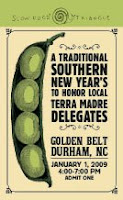 ...myself and two companions attended the Slow Food (Triangle) Terra Madre Recap event in Durham, North Carolina.
The event took place in one of the nicely-renovated Golden Belt Tobacco Company buildings. The event went well in my opinion, and the food was amazing (thanks to the people working the event and to the sponsors, such as Anson Mills of South Carolina).
The crowd there were mostly non-Southerners (a quick poll was taken by a show of hands; I think it was maybe 5%!), and everyone seemed to be quite friendly -- although a few people were hogging the "family-style" dishes of food and not passing them around. I was also a bit put off by the group of children that had turned the area behind my table into a racetrack of sorts, as I couldn't hear the announcer when he or she spoke due to the noise from the kids feet stompng.
Ok, negatives out of the way, the people running the event did a spectacular job, and the food was friggin' amazing. They ran out of collards quite quickly, but there was enough other food to fill the void. The cornbread, rice, and beans were all heirloom products from Anson Mills, and everything had pork in it (there were a few vegetarian options, but I'm thankful the food wasn't focused on that). Drinks were provided (water, tea, coffee), but it was BYOB (and many people did, including the Wine Authority guys who made me envy their line of bottles of wine they were sharing with friends and family).
I went expecting a more "Terra Madre experience" (I for some reason thought it would be local vendors, farmers, and etc., all at tables talking to visitors about their products), so it wasn't a "typical" Slow Food event experience I guess... but it was damn good and I wasn't disappointed. Post-meal, several Slow Food people talked about their experiences at Terra Madre in Italy, but I wasn't able to hear well due to the kids stomping around.
Thanks again to those who sponsored, hosted, and worked the event.
Tuesday, May 20, 2008
Recipe of the Month (May)
Almost forgot to post one this month! D'oh!
Anyway, I've decided to post one for Blackberry jam. The blackberry bushes on my property have for the most part dropped their blooms and the berries are starting to form, so it got me thinking about jam like my family traditionally makes...
Here's a basic recipe, mostly taken from Ball's Blue Book but also with some tips from various websites.
What you'll need:
- blackberries (fresh picked is best, but if unavailable, frozen will work)
- pectin
- organic sugar
- canning equipment (jars, lids, rings, etc.)
Jam can only be made in small batches (about six cups) at one time so the jam will "set" properly. It takes about eight cups of berries per batch.
Steps:
1. Wash jars, lids, rings, etc. so they'll be ready when you need them
2. Wash the berries
3. Crush the berries (and/or mill them if you want less seeds and less chunks in the jam) and put them in a large/suitable pot
4. Add the pectin (mix about 1/4 cup of sugar with it for easier mixing) into the berries
5. Cook on medium-to-high heat, stirring often enough so it doesn't burn (It should take about five to 10 minutes to get to a full boil)
6. Add the sugar; the recipe calls for four cups (!), but I use between two and three usually. (And don't forget you added 1/4 cup already with the pectin!)
7. Continue boiling for about one minute
8. Sterilize the canning jar lids and rings (again, so they'll be ready when you need them)
9. Skim the foam off the top of the pot (it's harmless, btw, but skim it off anyway)
10. Remove from heat
11. Test for jelling; use a cool spoon (one kept in a glass of ice water works), and scoop some of the jam out and see how long it takes to jell. If it isn't as thick as you like, add some more pectin and boil it again for about one minute
12. Let stand for five minutes, and stir (this step is optional)
13. Add to canning jars, put on lids and rings, and process (water bath) for five-to-ten minutes. Some people add a small squirt of lemon juice per jar at this point to raise acidity
14. Let cool. Listen for the lid pops!
Mmmm... can't wait for the blackberries to be pickable (mid-June or so in my area).
Anyway, I've decided to post one for Blackberry jam. The blackberry bushes on my property have for the most part dropped their blooms and the berries are starting to form, so it got me thinking about jam like my family traditionally makes...
Here's a basic recipe, mostly taken from Ball's Blue Book but also with some tips from various websites.
What you'll need:
- blackberries (fresh picked is best, but if unavailable, frozen will work)
- pectin
- organic sugar
- canning equipment (jars, lids, rings, etc.)
Jam can only be made in small batches (about six cups) at one time so the jam will "set" properly. It takes about eight cups of berries per batch.
Steps:
1. Wash jars, lids, rings, etc. so they'll be ready when you need them
2. Wash the berries
3. Crush the berries (and/or mill them if you want less seeds and less chunks in the jam) and put them in a large/suitable pot
4. Add the pectin (mix about 1/4 cup of sugar with it for easier mixing) into the berries
5. Cook on medium-to-high heat, stirring often enough so it doesn't burn (It should take about five to 10 minutes to get to a full boil)
6. Add the sugar; the recipe calls for four cups (!), but I use between two and three usually. (And don't forget you added 1/4 cup already with the pectin!)
7. Continue boiling for about one minute
8. Sterilize the canning jar lids and rings (again, so they'll be ready when you need them)
9. Skim the foam off the top of the pot (it's harmless, btw, but skim it off anyway)
10. Remove from heat
11. Test for jelling; use a cool spoon (one kept in a glass of ice water works), and scoop some of the jam out and see how long it takes to jell. If it isn't as thick as you like, add some more pectin and boil it again for about one minute
12. Let stand for five minutes, and stir (this step is optional)
13. Add to canning jars, put on lids and rings, and process (water bath) for five-to-ten minutes. Some people add a small squirt of lemon juice per jar at this point to raise acidity
14. Let cool. Listen for the lid pops!
Mmmm... can't wait for the blackberries to be pickable (mid-June or so in my area).
Sunday, May 18, 2008
Farmers, consumers, and organic food
I also came across two articles online regarding farmers, consumers, and organic food.
The first article, Natural Response: As prices of organic foods rise, plain old fruits and vegetables suddenly look better, shows not only the fickleness and apathy of the average consumer, but also that when it comes down to it, many (if not most) farmers want to make money over doing what is right for the consumer and the environment.
However, as I feel organic foodstuffs are overrated in many ways anyway, I'm glad to see that locally-produced foodstuffs are being preferred by consumers as they tend to be cheaper (mainly due to almost zero transportation costs) and fresher (and may be organic anyway, or perhaps even "beyond organic"). The second article, Shoppers Choosing Local Over Organics in Produce, addresses this issue/these issues.
One interesting statement from the second article is that "33 percent [of consumers] are concerned about the safety of organic produce." Is it because USDA organic standards have been lowered in many categories and also been manipulated by producers, or is it due to anti-organic propaganda like when organic spinach was blamed for the E. coli outbreak in late 2006, when in fact it was conventional bagged spinach?
The first article, Natural Response: As prices of organic foods rise, plain old fruits and vegetables suddenly look better, shows not only the fickleness and apathy of the average consumer, but also that when it comes down to it, many (if not most) farmers want to make money over doing what is right for the consumer and the environment.
However, as I feel organic foodstuffs are overrated in many ways anyway, I'm glad to see that locally-produced foodstuffs are being preferred by consumers as they tend to be cheaper (mainly due to almost zero transportation costs) and fresher (and may be organic anyway, or perhaps even "beyond organic"). The second article, Shoppers Choosing Local Over Organics in Produce, addresses this issue/these issues.
One interesting statement from the second article is that "33 percent [of consumers] are concerned about the safety of organic produce." Is it because USDA organic standards have been lowered in many categories and also been manipulated by producers, or is it due to anti-organic propaganda like when organic spinach was blamed for the E. coli outbreak in late 2006, when in fact it was conventional bagged spinach?
Subscribe to:
Posts (Atom)