
From a March 10, 2009 New York Times article:
"The former first lady, Laura Bush, insisted that fresh, organic foods be served in the White House, but did not broadcast that fact to the public, according to Walter Scheib, who served as executive chef under Presidents Bill Clinton and George W. Bush. 'She just didn’t talk much about it outside the house,' Mr. Scheib said of Mrs. Bush."
Hmmm... so while Laura is insisting that only organic food be served in the White House, hubby's policies are almost what one could call anti-organic? Perhaps she didn't mention it outside the White House so as not to upset her friends such as Rush Limbaugh or Matt Drudge?
And why did the American tax payer have to pay for organic food for a White House that enabled or even forced the "common folk" (i.e. us) to eat contaminated unhealthy industrially-produced garbage at times?
Saturday, March 14, 2009

Sunday, March 8, 2009
I am definitely wining
While I've liked wine for a long while now, I've recently been more "into" certain (and better) ones lately, and being the thrifty person I am, I've been hunting for inexpensive yet good wines. I live in Orange County, North Carolina, so some of my sources won't be applicable for anyone outside of this area.
Where do I get my wines?
1. Hillsborough Wine Company; my local wine merchant with a good selection of great-quality and many inexpensive wines, located in Hillsborough.
2. 3Cups; has some very cool artisinal, organic, and biodynamic wines, located in Chapel Hill.
3. Trader Joe's; has several inexpensive but good wines, located in Chapel Hill.
4. World Market; has a few inexpensive but good wines, located in Chapel Hill.
I'd always rather shop my local store, but sometimes just feel compelled to buy a quantity of inexpensive wine from, say, Trader Joe's, because I don't want to spent more than six or seven dollars for an "everyday wine" for myself.
However, often times my local wine shop can get wine for cheaper than discount places, particularly if I buy it by the case. For instance, my current favorite inexpensive wine is La Vieille Ferme Rouge Côtes du Ventoux, which is $6.99 a bottle at World Market; Hillsborough Wine Company sells it for $7.49 a bottle. However, World Market doesn't give a case discount, and HWC does; so I can get it for about $6.36 a bottle at HWC (a saving of 60 cents a bottle, or almost $8.00 a case -- which definitely adds up after while).
An interesting wine that I came across at Trader Joe's is a wine called La Ferme Julien Rouge Cotes du Ventoux. Its label resembles La Vieille Ferme Rouge Côtes du Ventoux (although it has a goat on it instead of two chickens and the color and font are different), and has the same composition: 50% Grenache, 20% Syrah, 15% Carignan, and 15% Cinsault. The bottle and cap look alike as well. It's supposed to be made by the same people (the Perrin family, who have a great reputation). Word on the street (well, the Internet) is that it's either a private labelling of the La Vieille Ferme, or a secondary bottling of it, or that it's from grapes from somewhere else on the same vineyard. It does get generally good ratings, with people either saying the two taste the same, or that the La Vieille Ferme is better, or that they're both bad. (I'll have to tray a few bottles and get back to you!) Robert Parker and the Wine Spectator both give the 2006 La Vieille Ferme an 87 rating, in case you're into that.
The only other inexpensive (meaning, under $7.00 or $8.00) wine I really like so far from Trader Joe's is the La Loggia Barbera D'Alba. I've always enjoyed Barbera D'Alba, and while this isn't the best one I've had by far, it is really tasty and is so inexpensive ($6.99 a bottle) that one can't complain. And for God's sake don't get the "Two Buck Chuck" (now at $2.99 a bottle) at Trader Joe's, unless you just don't give a darn what swill you drink...
Where do I get my wines?
1. Hillsborough Wine Company; my local wine merchant with a good selection of great-quality and many inexpensive wines, located in Hillsborough.
2. 3Cups; has some very cool artisinal, organic, and biodynamic wines, located in Chapel Hill.
3. Trader Joe's; has several inexpensive but good wines, located in Chapel Hill.
4. World Market; has a few inexpensive but good wines, located in Chapel Hill.
I'd always rather shop my local store, but sometimes just feel compelled to buy a quantity of inexpensive wine from, say, Trader Joe's, because I don't want to spent more than six or seven dollars for an "everyday wine" for myself.
However, often times my local wine shop can get wine for cheaper than discount places, particularly if I buy it by the case. For instance, my current favorite inexpensive wine is La Vieille Ferme Rouge Côtes du Ventoux, which is $6.99 a bottle at World Market; Hillsborough Wine Company sells it for $7.49 a bottle. However, World Market doesn't give a case discount, and HWC does; so I can get it for about $6.36 a bottle at HWC (a saving of 60 cents a bottle, or almost $8.00 a case -- which definitely adds up after while).
An interesting wine that I came across at Trader Joe's is a wine called La Ferme Julien Rouge Cotes du Ventoux. Its label resembles La Vieille Ferme Rouge Côtes du Ventoux (although it has a goat on it instead of two chickens and the color and font are different), and has the same composition: 50% Grenache, 20% Syrah, 15% Carignan, and 15% Cinsault. The bottle and cap look alike as well. It's supposed to be made by the same people (the Perrin family, who have a great reputation). Word on the street (well, the Internet) is that it's either a private labelling of the La Vieille Ferme, or a secondary bottling of it, or that it's from grapes from somewhere else on the same vineyard. It does get generally good ratings, with people either saying the two taste the same, or that the La Vieille Ferme is better, or that they're both bad. (I'll have to tray a few bottles and get back to you!) Robert Parker and the Wine Spectator both give the 2006 La Vieille Ferme an 87 rating, in case you're into that.
The only other inexpensive (meaning, under $7.00 or $8.00) wine I really like so far from Trader Joe's is the La Loggia Barbera D'Alba. I've always enjoyed Barbera D'Alba, and while this isn't the best one I've had by far, it is really tasty and is so inexpensive ($6.99 a bottle) that one can't complain. And for God's sake don't get the "Two Buck Chuck" (now at $2.99 a bottle) at Trader Joe's, unless you just don't give a darn what swill you drink...
Monday, January 26, 2009
FDA and USDA drop the bomb AGAIN
Scientists (this time at the Institute of Agriculture and Trade Policy) have once again found the FDA and USDA to be hiding health-relevant information from consumers. The latest? Many products containing high-fructose corn syrup (HFCS) contain mercury, due to the processing, uh... process. And what's the acceptable level of mercury in American consumers' food and drink, you ask? The answer?: Zero!
Again, hopefully with the new presidential administration in power, things like this will no longer happen, and the FDA and/or USDA will not sacrifice the American consumer so that a few crooked companies can force or keep their products on the shelves.
Read the report, Not So Sweet: Missing Mercury and High Fructose Corn Syrup, here.
Again, hopefully with the new presidential administration in power, things like this will no longer happen, and the FDA and/or USDA will not sacrifice the American consumer so that a few crooked companies can force or keep their products on the shelves.
Read the report, Not So Sweet: Missing Mercury and High Fructose Corn Syrup, here.
Tuesday, January 20, 2009
A great weight (both standard and metric) has been lifted

Hopefully a house cleaning will be undertaken in the U.S. government, getting rid of all (or at least most? Please?) of the ignorantly-idealistic, ill-suited, armchair commando, activist neo-cons who can't differentiate fact from fantasy. Well, hopefully the last eight years will show that their unsuited experiments of fantasy won't -- and didn't -- work. Their small ideas were once untested, but have now been tested - and their follies have been found to be greatly lacking and foolhardy. People so grossly unqualified should not be in charge of anything, much less a post that requires (demands!) intelligence and a comprehension of science.
I call on President Obama to change the course of America's future, and to do what's right for the people of this great country, and the world. Not for what's good for CEOs' annual bonuses, or for the middle-management of self-serving companies that would do harm to American (or world) citizens so that they can be lazy and save a few dollars and assure their stockholders of a profit the next quarter. But for all the others of us out there who will reap the harm caused by them currently and in the future. Because I really don't want three-eyed, one armed, flipper-footed, grossly overweight grandkids.
I call on President Obama to change the course of America's future, and to do what's right for the people of this great country, and the world. Not for what's good for CEOs' annual bonuses, or for the middle-management of self-serving companies that would do harm to American (or world) citizens so that they can be lazy and save a few dollars and assure their stockholders of a profit the next quarter. But for all the others of us out there who will reap the harm caused by them currently and in the future. Because I really don't want three-eyed, one armed, flipper-footed, grossly overweight grandkids.
Monday, January 12, 2009
Biodynamicificationicizing
I think I've finally decided to take the plunge and experiment on my smallest garden plot (about 25 by 25 feet) and prepare it to go biodynamic in 2010.
What is biodynamic you ask? Well, it's "beyond organic" in a sense, and it even kicks it up a few notches on the agricultural side of permaculture. Some aspects of it are a bit nutty in my opinion (it's really pretty much a homeopathic approach to soil), but biodynamically-produced products are friggin' amazing, and taste better than most organic products (and blow the doors off industrial organic). It brings out the terroir to its utmost.
For information on it all, peruse this Wikipedia article, this ATTRA publication, the Biodynamic Farming and Gardening Association website, the Pfeiffer Center's website, or the grandaddy of all biodynamic sources: Rudolph Steiner's Agriculture Course from 1924. (There are other reputable resources out there also, by the way). You can even get certified Biodynamic® by Demeter USA. Perhaps the most widely-known product that has taken the leap to being raised biodynamically is wine.
Anyway, since it basically takes a whole year to get the system started (I've already met the standards for organic), I won't be able to really "go" biodynamic until Spring 2010, but can prep my garden until I can do so.
I guess it's time to get some additional compost piles started...
What is biodynamic you ask? Well, it's "beyond organic" in a sense, and it even kicks it up a few notches on the agricultural side of permaculture. Some aspects of it are a bit nutty in my opinion (it's really pretty much a homeopathic approach to soil), but biodynamically-produced products are friggin' amazing, and taste better than most organic products (and blow the doors off industrial organic). It brings out the terroir to its utmost.
For information on it all, peruse this Wikipedia article, this ATTRA publication, the Biodynamic Farming and Gardening Association website, the Pfeiffer Center's website, or the grandaddy of all biodynamic sources: Rudolph Steiner's Agriculture Course from 1924. (There are other reputable resources out there also, by the way). You can even get certified Biodynamic® by Demeter USA. Perhaps the most widely-known product that has taken the leap to being raised biodynamically is wine.
Anyway, since it basically takes a whole year to get the system started (I've already met the standards for organic), I won't be able to really "go" biodynamic until Spring 2010, but can prep my garden until I can do so.
I guess it's time to get some additional compost piles started...
Saturday, January 10, 2009
A cool local event heads up
 This Real Food Real Medicine event sounds amazing. BUT, I won't be able to attend due to the cost of admission. $75 for a student? $100 for a farmer? $180+ for everyone else? C'mon! Oh well, even though it sounds cool, I guess all the well-to-do professors and yuppie foodies will be able to go. Perhaps I'll be able to read about it in some journal one day...
It's February 27 - March 1, by the way.
Sunday, January 4, 2009
Chicken update
I thought I'd just put a chicken update out there for all (ahem) to read. So, here goes:
1. My Sussex chickens have all been killed by raccoons. So, I'm going to have to start over, but only better this time. What to do about it? Well, I haven't yet fenced in my property entirely, so I'll either have to do that or keep my flock within a smaller area of electric fencing; also, some raccoons must (will) perish.
2. I've finally become a member of the American Livestock Breeds Conservancy, and they'll be able to help me with my Sussex breeding program.
3. I'm almost through with my annual chicken slaughtering; all my Buff Plymouth Rocks are in the freezer, and I'm starting on my Delawares. I've had some communication problems with my farmers' market, so I may have them all to myself instead of selling most of them like I intended. It's too bad, too: I raised the birds well, and they've been tasting GOOD.
4. I've made a tentative list of chicks to buy in the early spring: mostly Sussexes, but I also plan on getting a Dominique or two and a Dorking.
1. My Sussex chickens have all been killed by raccoons. So, I'm going to have to start over, but only better this time. What to do about it? Well, I haven't yet fenced in my property entirely, so I'll either have to do that or keep my flock within a smaller area of electric fencing; also, some raccoons must (will) perish.
2. I've finally become a member of the American Livestock Breeds Conservancy, and they'll be able to help me with my Sussex breeding program.
3. I'm almost through with my annual chicken slaughtering; all my Buff Plymouth Rocks are in the freezer, and I'm starting on my Delawares. I've had some communication problems with my farmers' market, so I may have them all to myself instead of selling most of them like I intended. It's too bad, too: I raised the birds well, and they've been tasting GOOD.
4. I've made a tentative list of chicks to buy in the early spring: mostly Sussexes, but I also plan on getting a Dominique or two and a Dorking.
On New Years Day...
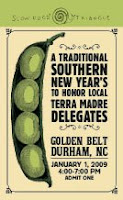 ...myself and two companions attended the Slow Food (Triangle) Terra Madre Recap event in Durham, North Carolina.
The event took place in one of the nicely-renovated Golden Belt Tobacco Company buildings. The event went well in my opinion, and the food was amazing (thanks to the people working the event and to the sponsors, such as Anson Mills of South Carolina).
The crowd there were mostly non-Southerners (a quick poll was taken by a show of hands; I think it was maybe 5%!), and everyone seemed to be quite friendly -- although a few people were hogging the "family-style" dishes of food and not passing them around. I was also a bit put off by the group of children that had turned the area behind my table into a racetrack of sorts, as I couldn't hear the announcer when he or she spoke due to the noise from the kids feet stompng.
Ok, negatives out of the way, the people running the event did a spectacular job, and the food was friggin' amazing. They ran out of collards quite quickly, but there was enough other food to fill the void. The cornbread, rice, and beans were all heirloom products from Anson Mills, and everything had pork in it (there were a few vegetarian options, but I'm thankful the food wasn't focused on that). Drinks were provided (water, tea, coffee), but it was BYOB (and many people did, including the Wine Authority guys who made me envy their line of bottles of wine they were sharing with friends and family).
I went expecting a more "Terra Madre experience" (I for some reason thought it would be local vendors, farmers, and etc., all at tables talking to visitors about their products), so it wasn't a "typical" Slow Food event experience I guess... but it was damn good and I wasn't disappointed. Post-meal, several Slow Food people talked about their experiences at Terra Madre in Italy, but I wasn't able to hear well due to the kids stomping around.
Thanks again to those who sponsored, hosted, and worked the event.
Thursday, December 18, 2008
Oh! bama
On Wednesday, President-elect Barrack Obama appointed former Iowa governor Thomas Vilsack as his USDA chief. And previously, Obama appointed former Monsanto vice-president Michael R. Taylor to his transition team.
There's just not many positives to having either of those two creeps in this administration... I guess Change™ doesn't apply to our food chain. Perhaps next, Richard L. Bond will be made head of the FDA.
(Update: and then there's this article, written by Obama's chief adviser on agricultural issues, Marshall Matz. It's all "blah, blah, industrial agricultural is so great, blah blah..." yikes.)
Disappointing to say the least. I expected better this time around, but I guess we'll just have to wait and see what comes of it (and hopefully it won't kill us or give us cancer).
There's just not many positives to having either of those two creeps in this administration... I guess Change™ doesn't apply to our food chain. Perhaps next, Richard L. Bond will be made head of the FDA.
(Update: and then there's this article, written by Obama's chief adviser on agricultural issues, Marshall Matz. It's all "blah, blah, industrial agricultural is so great, blah blah..." yikes.)
Disappointing to say the least. I expected better this time around, but I guess we'll just have to wait and see what comes of it (and hopefully it won't kill us or give us cancer).
Thursday, June 26, 2008
You stupid donkey... yes?!?
I've become totally obsessed with several of Gordon Ramsay's television shows lately: Hell's Kitchen, The F Word, and Kitchen Nightmares.
I've been watching Hell's Kitchen on T.V. mainly, but catch-up on any missed shows on Hulu. The F Word I've been watching in cut-up episodes on YouTube (since it's only on BBC television and I can't seem to find it in any of my local video stores), and Kitchen Nightmares also on Hulu. Hulu's a great website that has high-quality, full-length T.V. shows and movies (even though it has commercials), and although it can sometimes take awhile to find someone who has posted quality videos on YouTube, it's well worth hunting around.
Man, Gordon Ramsay definitely has balls. He definitely appears to have earned every bit of his success, and likely has an amazing team of people surrounding him that assist him in fulfilling his vision(s) of providing great food in an amazing environment. I have learned so very much about cooking, about food, by just watching him in action in his shows. One of his cookbooks will likely be my next food-related book purchase.
Another cool thing about watching the F Word is that I was introduced to the work of Hugh Fearnley-Whittingstall, of River Cottage fame, and purchased his Meat book.
I've been watching Hell's Kitchen on T.V. mainly, but catch-up on any missed shows on Hulu. The F Word I've been watching in cut-up episodes on YouTube (since it's only on BBC television and I can't seem to find it in any of my local video stores), and Kitchen Nightmares also on Hulu. Hulu's a great website that has high-quality, full-length T.V. shows and movies (even though it has commercials), and although it can sometimes take awhile to find someone who has posted quality videos on YouTube, it's well worth hunting around.
Man, Gordon Ramsay definitely has balls. He definitely appears to have earned every bit of his success, and likely has an amazing team of people surrounding him that assist him in fulfilling his vision(s) of providing great food in an amazing environment. I have learned so very much about cooking, about food, by just watching him in action in his shows. One of his cookbooks will likely be my next food-related book purchase.
Another cool thing about watching the F Word is that I was introduced to the work of Hugh Fearnley-Whittingstall, of River Cottage fame, and purchased his Meat book.
Tuesday, June 10, 2008
Meat madness
Wow... South Korea's government has been almost wiped out by a mass "resignation" of ministry officials from the public outcry and protests over a deal to allow U.S. industrial beef imports to resume. I was feeling rather chagrined when I found out that the U.S. had pushed industrial beef on to the unsuspecting Korean people as part of a trade agreement. But... apparently, they weren't as unsuspecting as I thought, as the Korean government has found out, much to its chagrin. Too bad the average U.S., consumer won't stand up to its own government and protest the lousy meats that are forced upon him or her; you'd think with all the current health problems and the massive meat recalls that people would finally realize what's going on and say no to industrial meat. But oh well...
In other news, perhaps caused by industrial meat contamination: tomatoes recall. But, at least it's apparently prompting the FDA to finally want to do its job, and the government to financially support the FDA so that it can do so.
Perhaps the FDA will be able to head off what appears to be the next major food disaster before it wipes out too many people. Stay tuned for MRSA.
In other news, perhaps caused by industrial meat contamination: tomatoes recall. But, at least it's apparently prompting the FDA to finally want to do its job, and the government to financially support the FDA so that it can do so.
Perhaps the FDA will be able to head off what appears to be the next major food disaster before it wipes out too many people. Stay tuned for MRSA.
Thursday, May 22, 2008
Follow the organic food trail
Philip H. Howard, Assistant Professor of the Department of Community, Agriculture, Recreation and Resource Studies at Michigan State University, has a really informative website that charts out the relationship(s) of various organic food-producing companies (brought to my attention by Anna Lappe's blog).
Check it out here.
Wednesday, May 21, 2008
Humane Foie Gras?
I just watched a video excerpt of British chef Gordon Ramsay's TV show The F Word on You Tube.
A woman, noticing that Chef Ramsay served foie gras at all of his restaurants on every menu, attempted to get Ramsay to change his ways and serve an ethically-produced foie gras that she had heard about from Spain.
After visiting a foie gras farm in France (the traditional one), and the one in Spain (the ethical one), she tasted both and declared that the Spanish farm's product has "all the taste and none of the cruelty" of the traditional French method.
However, in a blind taste test, Ramsay noted that the ethically-produced one had a different (and less-desirable) taste and texture than the one he normally serves. He did state that the geese that supply his livers for the foie gras were "half-forced" fed and treated humanely. I'd like to see a video of his supplier's farm, though, to compare!
The video of the French farm certainly didn't seem to treat the geese humanely, as they were kept indoors in a small pen, and the force-feeding definitely appeared to be cruel. The livers that came out of the geese were huge!
At the Spanish farm, the geese were clearly raised humanely, living outdoors in an orchard (definitely free range); I believe they may have even been semi-wild geese, as they appeared to be free to fly/migrate away if they were to so choose. The livers that came out of those geese, however, were much smaller (by at least half to two-thirds) than the French geese. But, this shows to me that the farmer was more concerned with the ethical treatment of his animals than a larger potential profit on his product.
I'm not sure if I've ever even eaten foie gras, but it does sound tasty. I'd like to see if it is available locally in its humane form. It does have that ethical dilemma, however, hanging over the product, much like veal (which can be raised humanely, just not by CAFOs).
The TV show is excellent, by the way, in that it shows the process of [humanely] raising livestock (tukreys, pigs, and sheep) all the way through to the slaughter of them; even PETA supported the showing of the entire process on the show. It will definitely make you a vegetarian if you can't stand it. One can only imagine the horror of a industrial slaughterhouse...
A woman, noticing that Chef Ramsay served foie gras at all of his restaurants on every menu, attempted to get Ramsay to change his ways and serve an ethically-produced foie gras that she had heard about from Spain.
After visiting a foie gras farm in France (the traditional one), and the one in Spain (the ethical one), she tasted both and declared that the Spanish farm's product has "all the taste and none of the cruelty" of the traditional French method.
However, in a blind taste test, Ramsay noted that the ethically-produced one had a different (and less-desirable) taste and texture than the one he normally serves. He did state that the geese that supply his livers for the foie gras were "half-forced" fed and treated humanely. I'd like to see a video of his supplier's farm, though, to compare!
The video of the French farm certainly didn't seem to treat the geese humanely, as they were kept indoors in a small pen, and the force-feeding definitely appeared to be cruel. The livers that came out of the geese were huge!
At the Spanish farm, the geese were clearly raised humanely, living outdoors in an orchard (definitely free range); I believe they may have even been semi-wild geese, as they appeared to be free to fly/migrate away if they were to so choose. The livers that came out of those geese, however, were much smaller (by at least half to two-thirds) than the French geese. But, this shows to me that the farmer was more concerned with the ethical treatment of his animals than a larger potential profit on his product.
I'm not sure if I've ever even eaten foie gras, but it does sound tasty. I'd like to see if it is available locally in its humane form. It does have that ethical dilemma, however, hanging over the product, much like veal (which can be raised humanely, just not by CAFOs).
The TV show is excellent, by the way, in that it shows the process of [humanely] raising livestock (tukreys, pigs, and sheep) all the way through to the slaughter of them; even PETA supported the showing of the entire process on the show. It will definitely make you a vegetarian if you can't stand it. One can only imagine the horror of a industrial slaughterhouse...
Tuesday, May 20, 2008
Recipe of the Month (May)
Almost forgot to post one this month! D'oh!
Anyway, I've decided to post one for Blackberry jam. The blackberry bushes on my property have for the most part dropped their blooms and the berries are starting to form, so it got me thinking about jam like my family traditionally makes...
Here's a basic recipe, mostly taken from Ball's Blue Book but also with some tips from various websites.
What you'll need:
- blackberries (fresh picked is best, but if unavailable, frozen will work)
- pectin
- organic sugar
- canning equipment (jars, lids, rings, etc.)
Jam can only be made in small batches (about six cups) at one time so the jam will "set" properly. It takes about eight cups of berries per batch.
Steps:
1. Wash jars, lids, rings, etc. so they'll be ready when you need them
2. Wash the berries
3. Crush the berries (and/or mill them if you want less seeds and less chunks in the jam) and put them in a large/suitable pot
4. Add the pectin (mix about 1/4 cup of sugar with it for easier mixing) into the berries
5. Cook on medium-to-high heat, stirring often enough so it doesn't burn (It should take about five to 10 minutes to get to a full boil)
6. Add the sugar; the recipe calls for four cups (!), but I use between two and three usually. (And don't forget you added 1/4 cup already with the pectin!)
7. Continue boiling for about one minute
8. Sterilize the canning jar lids and rings (again, so they'll be ready when you need them)
9. Skim the foam off the top of the pot (it's harmless, btw, but skim it off anyway)
10. Remove from heat
11. Test for jelling; use a cool spoon (one kept in a glass of ice water works), and scoop some of the jam out and see how long it takes to jell. If it isn't as thick as you like, add some more pectin and boil it again for about one minute
12. Let stand for five minutes, and stir (this step is optional)
13. Add to canning jars, put on lids and rings, and process (water bath) for five-to-ten minutes. Some people add a small squirt of lemon juice per jar at this point to raise acidity
14. Let cool. Listen for the lid pops!
Mmmm... can't wait for the blackberries to be pickable (mid-June or so in my area).
Anyway, I've decided to post one for Blackberry jam. The blackberry bushes on my property have for the most part dropped their blooms and the berries are starting to form, so it got me thinking about jam like my family traditionally makes...
Here's a basic recipe, mostly taken from Ball's Blue Book but also with some tips from various websites.
What you'll need:
- blackberries (fresh picked is best, but if unavailable, frozen will work)
- pectin
- organic sugar
- canning equipment (jars, lids, rings, etc.)
Jam can only be made in small batches (about six cups) at one time so the jam will "set" properly. It takes about eight cups of berries per batch.
Steps:
1. Wash jars, lids, rings, etc. so they'll be ready when you need them
2. Wash the berries
3. Crush the berries (and/or mill them if you want less seeds and less chunks in the jam) and put them in a large/suitable pot
4. Add the pectin (mix about 1/4 cup of sugar with it for easier mixing) into the berries
5. Cook on medium-to-high heat, stirring often enough so it doesn't burn (It should take about five to 10 minutes to get to a full boil)
6. Add the sugar; the recipe calls for four cups (!), but I use between two and three usually. (And don't forget you added 1/4 cup already with the pectin!)
7. Continue boiling for about one minute
8. Sterilize the canning jar lids and rings (again, so they'll be ready when you need them)
9. Skim the foam off the top of the pot (it's harmless, btw, but skim it off anyway)
10. Remove from heat
11. Test for jelling; use a cool spoon (one kept in a glass of ice water works), and scoop some of the jam out and see how long it takes to jell. If it isn't as thick as you like, add some more pectin and boil it again for about one minute
12. Let stand for five minutes, and stir (this step is optional)
13. Add to canning jars, put on lids and rings, and process (water bath) for five-to-ten minutes. Some people add a small squirt of lemon juice per jar at this point to raise acidity
14. Let cool. Listen for the lid pops!
Mmmm... can't wait for the blackberries to be pickable (mid-June or so in my area).
Soylent Green, the sequel?
Yikes... instead of eliminating or bypassing CAFOs and the associated animal suffering, environmentally-hazardous waste disposal, overuse and misuse of antibiotics, and etc., by raising humanely-raised livestock on small family farms, some people seem to want to go the other way: to growing meat in a laboratory. I can't think of anything more repungnant, except maybe eating Soylent Green (which actually, and scarily, isn't all that different according to what happens in the movie, minus the human element as raw material, of course).
Read these articles and decide for yourself:
Will Lab-Grown Meat Save the Planet?
Tastes Like Chicken: Growing meat without growing animals
Read these articles and decide for yourself:
Will Lab-Grown Meat Save the Planet?
Tastes Like Chicken: Growing meat without growing animals
Sunday, May 18, 2008
Farmers, consumers, and organic food
I also came across two articles online regarding farmers, consumers, and organic food.
The first article, Natural Response: As prices of organic foods rise, plain old fruits and vegetables suddenly look better, shows not only the fickleness and apathy of the average consumer, but also that when it comes down to it, many (if not most) farmers want to make money over doing what is right for the consumer and the environment.
However, as I feel organic foodstuffs are overrated in many ways anyway, I'm glad to see that locally-produced foodstuffs are being preferred by consumers as they tend to be cheaper (mainly due to almost zero transportation costs) and fresher (and may be organic anyway, or perhaps even "beyond organic"). The second article, Shoppers Choosing Local Over Organics in Produce, addresses this issue/these issues.
One interesting statement from the second article is that "33 percent [of consumers] are concerned about the safety of organic produce." Is it because USDA organic standards have been lowered in many categories and also been manipulated by producers, or is it due to anti-organic propaganda like when organic spinach was blamed for the E. coli outbreak in late 2006, when in fact it was conventional bagged spinach?
The first article, Natural Response: As prices of organic foods rise, plain old fruits and vegetables suddenly look better, shows not only the fickleness and apathy of the average consumer, but also that when it comes down to it, many (if not most) farmers want to make money over doing what is right for the consumer and the environment.
However, as I feel organic foodstuffs are overrated in many ways anyway, I'm glad to see that locally-produced foodstuffs are being preferred by consumers as they tend to be cheaper (mainly due to almost zero transportation costs) and fresher (and may be organic anyway, or perhaps even "beyond organic"). The second article, Shoppers Choosing Local Over Organics in Produce, addresses this issue/these issues.
One interesting statement from the second article is that "33 percent [of consumers] are concerned about the safety of organic produce." Is it because USDA organic standards have been lowered in many categories and also been manipulated by producers, or is it due to anti-organic propaganda like when organic spinach was blamed for the E. coli outbreak in late 2006, when in fact it was conventional bagged spinach?
Natural selection
I came across this article in a local newspaper: Drought takes toll on Leyland cypress trees. I had to smile while reading it, as I despise the tree, and feel that it symbolizes all that is wrong with mediocre (design-wise) and unsympathetic (to their environment/s) housing and landscaping.
The tree is apparently drought-sensitive, and Robert Jackson, a professor of global environmental change and biology at Duke University's Nicholas School of the Environment, speculated that "a fungal disease may have contributed to the death of the trees," and that "extreme temperatures and drought can weaken trees, making them more susceptible to pathogens."
A landscape architect and urban forester at the Chapel Hill Public Works Department "recommended that landowners instead plant the Eastern red cedar, a native tree that looks like the Leyland cyprus but is hardier." So, it turns out that a native tree is replacing a tree that is unsuitable for the local climate... imagine that.
The tree is apparently drought-sensitive, and Robert Jackson, a professor of global environmental change and biology at Duke University's Nicholas School of the Environment, speculated that "a fungal disease may have contributed to the death of the trees," and that "extreme temperatures and drought can weaken trees, making them more susceptible to pathogens."
A landscape architect and urban forester at the Chapel Hill Public Works Department "recommended that landowners instead plant the Eastern red cedar, a native tree that looks like the Leyland cyprus but is hardier." So, it turns out that a native tree is replacing a tree that is unsuitable for the local climate... imagine that.
Wednesday, May 14, 2008
Chillin' at the mill
Just got back from a two-day [semi-marathon] road trip through South Carolina, and one of the things I finally did (after putting it off for three years) was visit Anson Mills off Gervais Street in downtown Columbia.
They have a very cool set up, with several types of mills (several are from Meadows Mills in North Wilkesboro, N.C.) and a whole lotta chest freezers (in which they freeze their pre-ground corn and their finished products) throughout their warehouse.
I was able to obtain some buckwheat flour, oat flour, blue grits (made from Cherokee Blue corn), and rice grits.
Can't wait to cook with them! First, I think I'm going to make Anson Mills' recipe "Carolina Gold Rice Grits with Shallots and Celery" as a side to a "Poulet Rouge" chicken from Ashley Farms/Joyce Foods. Mmmm...
(The other foodie highlight in S.C. was Cooper's Country Store in/near Salters, where I bought two BBQ turkey sandwiches, a bag of boiled peanuts, and some salt and vinegar pork rinds for my dinner; they are "famous" for their country hams, which I assumed are produced on premise, but may not be -- they are also somewhat mysteriously "famous" for their rice cookers/steamers. Their meat counter made me seriously drool.)
They have a very cool set up, with several types of mills (several are from Meadows Mills in North Wilkesboro, N.C.) and a whole lotta chest freezers (in which they freeze their pre-ground corn and their finished products) throughout their warehouse.
I was able to obtain some buckwheat flour, oat flour, blue grits (made from Cherokee Blue corn), and rice grits.
Can't wait to cook with them! First, I think I'm going to make Anson Mills' recipe "Carolina Gold Rice Grits with Shallots and Celery" as a side to a "Poulet Rouge" chicken from Ashley Farms/Joyce Foods. Mmmm...
(The other foodie highlight in S.C. was Cooper's Country Store in/near Salters, where I bought two BBQ turkey sandwiches, a bag of boiled peanuts, and some salt and vinegar pork rinds for my dinner; they are "famous" for their country hams, which I assumed are produced on premise, but may not be -- they are also somewhat mysteriously "famous" for their rice cookers/steamers. Their meat counter made me seriously drool.)
Subscribe to:
Posts (Atom)